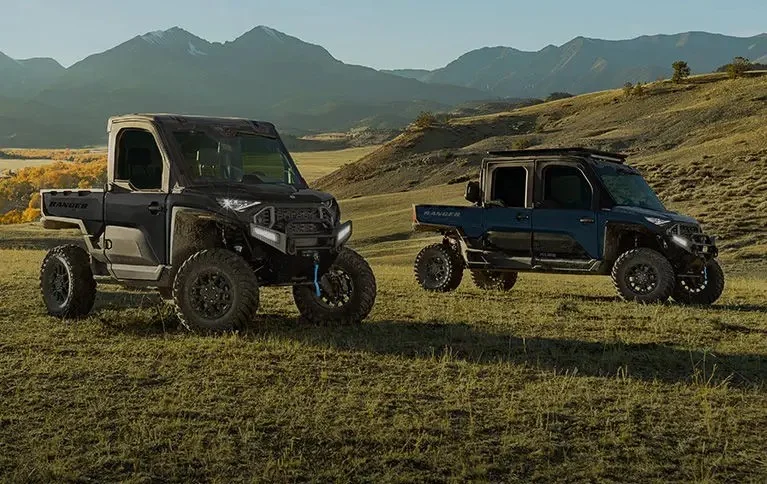
Compare the Polaris Ranger XP 1000 vs. XD 1500. See towing, payload, STEELDRIVE vs. CVT, cab options, and maneuverability to pick the right work UTV.
Polaris Ranger XP 1000 vs. Ranger XD 1500: How Much Ranger Do You Actually Need?
The Polaris Ranger XD 1500 is bigger, stronger, and more capable than the Ranger XP 1000—but that doesn’t automatically mean it’s the right machine for your property. For a lot of owners, the Ranger XP 1000 is already more than enough side-by-side. The real question isn’t which machine wins on a spec sheet; it’s whether your daily workload will actually use what the XD 1500 adds.
Ranger XP 1000 vs. XD 1500 at a Glance
| Specification | Polaris Ranger XP 1000 | Polaris Ranger XD 1500 |
|---|---|---|
| Engine | 999cc ProStar twin | 1,498cc ProStar triple |
| Horsepower | 82 hp | 110 hp |
| Torque | — | 105 lb-ft |
| Transmission | Pro-PVT CVT | STEELDRIVE |
| Cargo Box Capacity | 1,000 lb | 1,500 lb |
| Towing Capacity | 2,500 lb | 3,500 lb |
| Ground Clearance | 14 in. | 15 in. |
| Standard & Crew Models | Yes | Yes |
| Factory HVAC Available | Yes | Yes |
That jump in horsepower, torque, bed capacity, and towing is meaningful—but it isn’t free capability. Beyond the higher price tag, the XD 1500 is a physically larger, heavier-duty machine engineered for a different class of work.
Engine & Power
Ranger XP 1000
The XP 1000 runs Polaris’ 999cc ProStar twin-cylinder engine rated at 82 horsepower. For most UTV owners, 82 horsepower is never a limitation—it easily handles farm work, ranch chores, hunting, snow plowing, trail riding, and pulling standard utility trailers.
Ranger XD 1500
The XD 1500 steps up to a 1,498cc three-cylinder ProStar engine producing 110 horsepower and 105 lb-ft of torque. While the horsepower bump gets attention, the torque is the real story. The XD is built to move heavy weight cleanly off the line; if you regularly start on a hill with a loaded trailer or operate near maximum capacity, that extra low-end torque makes a noticeable difference.
- Winner: XD 1500—if your workload consistently puts heavy loads behind the hitch.
Transmission: Pro-PVT vs. STEELDRIVE
This is arguably the biggest mechanical difference between the two platforms.
- XP 1000 (Pro-PVT): Uses Polaris’ conventional powersports CVT with High, Low, Neutral, Reverse, and Park. It is proven, familiar, and straightforward for everyday ranch and trail use.
- XD 1500 (STEELDRIVE): Replaces the conventional rubber drive belt with a sealed, liquid-cooled, steel-constructed belt system and electronically controlled shifting. Built specifically for extreme-duty operation, STEELDRIVE excels at repetitive low-speed hauling, hill starts, and maneuvering heavy loads without belt wear.
- Winner: XD 1500 for extreme-duty hauling; the XP 1000’s Pro-PVT remains ideal for conventional UTV work.
Towing & Cargo Box Capacity
Towing: 2,500 lb vs. 3,500 lb
The XD 1500 adds an extra 1,000 pounds of rated towing capacity. Ask yourself what you realistically hitch up: if your typical trailer weighs 1,200 pounds loaded, the XD’s higher rating won’t change your day-to-day experience. If you routinely approach or exceed 2,500 pounds, the XD becomes the clear choice.
Cargo Box: 1,000 lb vs. 1,500 lb
Alongside its 1,500-pound weight rating, Polaris designs the XD 1500 cargo box with 50% more volume than conventional full-size UTV beds. That added capacity is a major asset for bulk feed, firewood, fencing supplies, landscaping materials, and commercial gear. For coolers, hunting equipment, and everyday ranch tools, however, the XP 1000’s 1,000-pound bed is already substantial.
Ground Clearance & Maneuverability
The XP 1000 offers 14 inches of ground clearance compared to 15 inches on the XD 1500. One inch alone isn’t a reason to buy the XD, though paired with its larger chassis and tires, it reinforces its heavy-duty build. Where the XP 1000 pushes back is maneuverability. When space gets tight around barn aisles, narrow gates, equipment sheds, wooded trails, and standard utility trailers, the XP 1000 is noticeably easier to turn, park, and load. The XD’s larger footprint provides rock-solid stability under heavy loads, but bigger is still bigger when you’re working around livestock pens and outbuildings.
Cab Options & Comfort
For 2027, Polaris offers the Ranger XP 1000 CAB with factory heat and air conditioning alongside its NorthStar configurations. That is a major factor in this comparison: you no longer have to step up into the XD 1500 just to get a serious, factory-sealed climate-controlled cab. The XD NorthStar still delivers the larger Extreme Duty chassis, but HVAC alone is no longer a reason to upsize.
Side-by-Side Use-Case Breakdown
Which Is Better for Ranch Work?
- Choose the Ranger XP 1000 if: You tow under 2,500 pounds, a 1,000-pound bed meets your needs, you navigate tight gates and barns, you also ride trails, or you want factory HVAC without paying for extreme-duty hardware.
- Choose the Ranger XD 1500 if: Heavy towing over 2,500 pounds is central to your operation, you routinely fill a 1,000-pound bed to capacity, you log high commercial work hours, or you want the durability of STEELDRIVE.
Which Is Better for Hunting?
Ranger XP 1000. Unless you are hauling a heavy camp trailer or transporting unusually large loads out of rugged backcountry, the XP 1000’s nimbler footprint makes it easier to navigate tight two-tracks and timber.
Which Is Better for Snow Plowing?
It depends on the property. The XD 1500’s added curb weight, torque, and STEELDRIVE transmission shine on large commercial lots, steep mountain drives, and long ranch roads. For standard driveways and typical property lanes, the XP 1000 is already a highly capable plow rig.
Which Is Better for Trail Riding?
Ranger XP 1000. While the XD 1500 can handle trails, it is engineered around heavy-duty utility first. The XP 1000 strikes a much better work/play balance for owners who spend weekends on the trails after chores are done.
Quick Decision Guide: How Much Ranger Do You Need?
| Primary Use Case | Start With |
|---|---|
| General property maintenance | Ranger XP 1000 |
| Hunting & backcountry access | Ranger XP 1000 |
| Mixed trail riding + work | Ranger XP 1000 |
| Standard driveway & road snow plowing | Ranger XP 1000 |
| Heavy ranch towing (2,500–3,500 lb) | Ranger XD 1500 |
| Commercial & high-hour jobsite work | Ranger XD 1500 |
| Regular 1,000+ lb cargo bed loads | Ranger XD 1500 |
| Maximum payload & towing capability | Ranger XD 1500 |
Final Verdict
The Polaris Ranger XD 1500 wins nearly every maximum-capacity specification—and for heavy commercial operators and large ranches, it earns its keep every single day. Still, the Ranger XP 1000 remains the smarter purchase for a wider range of buyers, delivering 82 horsepower, 2,500 pounds of towing, a 1,000-pound bed, 14 inches of clearance, and factory HVAC options in a more agile package. The XD 1500 makes sense the moment you can point to a specific, recurring job that demands its extra muscle. At Edge Performance Sports in Ontario, Oregon, you can compare both Ranger platforms side by side—checking cab space, bed dimensions, and overall footprint in person rather than guessing from a spec sheet. Stop by our Ontario showroom today to see which Ranger fits the way you actually work.