
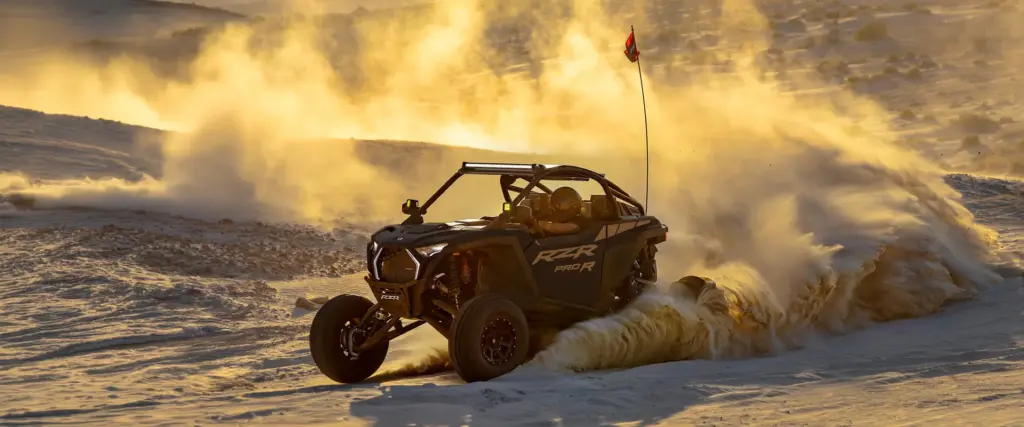
Compare the Polaris RZR vs. Can-Am Maverick lineups. Evaluate Trail, XP, Pro, X3, and flagship Pro R vs. Maverick R models for desert and trail riding.
The matchup between the Polaris RZR and the Can-Am Maverick is the defining rivalry of the sport side-by-side (UTV) market.
Both lineups offer two-seat and four-seat configurations built for everything from tight forest trails to wide-open desert whoops, sand dunes, and technical rock crawling. However, choosing between them comes down to far more than brand loyalty. Both manufacturers segment their platforms into distinct performance tiers defined by vehicle width, engine architecture, suspension travel, and intended terrain.
Understanding how these engineering decisions perform on the trail is key to making the right choice. Here is a comprehensive side-by-side comparison of the complete RZR and Maverick lineups.
Lineup Overview at a Glance
| Performance Tier | Polaris RZR Lineup | Can-Am Maverick Lineup | Primary Terrain & Focus |
|---|---|---|---|
| 50″ – 60″ Trail | RZR Trail / Trail S | Maverick Trail | Width-restricted public trails, tight woods, light recreation. |
| All-Around Sport | RZR XP / XP S | Maverick Sport | Balanced trail & desert riding, general weekend exploration. |
| High Performance | RZR Pro XP / Pro S | Maverick X3 / X3 MAX | High-speed desert washes, dunes, rough whoops, technical trails. |
| Flagship / Extreme | RZR Pro R / Pro R Boost | Maverick R / Maverick R MAX | Extreme desert racing, massive suspension demands, maximum HP. |
1. Trail Category: RZR Trail vs. Maverick Trail
For riders navigating width-restricted 50-inch or 60-inch public trails, compact dimensions and precise maneuverability take priority over extreme horsepower.
Polaris RZR Trail & Trail S
The RZR Trail platform focuses heavily on agility. With a shorter wheelbase and quick-ratio steering, it excels at flicking through tight tree lines and technical switchbacks. The standard Trail stays within 50 inches for strict forest routes, while the Trail S widens to 60 inches, adding travel and stability without sacrificing woods access.
- Key Mechanicals: ProStar 900 twin-cylinder engine, dual A-arm suspension, fast-engaging All-Wheel Drive.
- Rider Fit: Best for riders who prioritize light vehicle weight, tight cornering, and simple trail navigation.
Can-Am Maverick Trail
Can-Am took a different design approach with the Maverick Trail. It features a longer wheelbase than its Polaris counterpart, placing the wheels closer to the corners of the machine. This layout creates a remarkably smooth, planted feel over washboard surfaces and rutted tracks, reducing the pitching motion often felt in short-wheelbase trail machines.
- Key Mechanicals: Rotax V-Twin engine options (500cc or 1000cc), Torsional Trailing arm Independent (TTI) rear suspension.
- Rider Fit: Ideal for trail riders who want high cockpit comfort, linear power delivery, and high-speed tracking on narrow routes.
2. All-Around Sport Category: RZR XP vs. Maverick Sport
The mid-tier sport segment is the most popular choice for recreational riders. These machines offer significantly more suspension travel and ground clearance than trail models, allowing them to tackle desert hardpack, rocky climbs, and open tracks without the aggressive price tag of flagship turbo platforms.
Polaris RZR XP & XP S
The RZR XP is a cornerstone of off-road culture. Built around a rigid chassis and powered by the naturally aspirated ProStar 1000 Gen 2 engine, it delivers dependable, linear power. The upgraded RZR XP S expands the stance to 64 inches, yielding greater high-speed cornering stability and longer shock strokes.
- Cockpit & Ergonomics: High-backed bucket seats, upright seating posture for clear sightlines, and integrated full doors.
- Terrain Suitability: Excellent all-rounder for high-desert two-tracks, mountain trails, and rocky washes.
Can-Am Maverick Sport
Can-Am’s answer in this segment is the Maverick Sport. Utilising a 60-inch or 64-inch track width depending on trim, it features the Rotax 1000R V-Twin engine producing 100 horsepower. The chassis utilizes curved A-arms to maximize center ground clearance when straddling sharp rocks and deep ruts.
- Cockpit & Ergonomics: Low-profile Ergo-Lok seating position that lowers the center of gravity and cradles the driver inside the frame.
- Terrain Suitability: Ideal for fast forest fire roads, desert exploration, and sweeping trails where high-speed stability is key.
3. High-Performance Desert & Dunes: RZR Pro Series vs. Maverick X3
When stepping into high-performance territory, machines transition to turbocharged powerplants, heavy-duty long-travel suspension, and reinforced roll cages designed to handle harsh desertwhoops and steep dune faces.
| Feature | Polaris RZR | Can-Am Maverick |
|---|---|---|
| Drivetrain System | High-output CVT with PVT clutches across the lineup. | QRS-X CVT (X3 models) / 7-Speed Dual-Clutch DCT (Maverick R). |
| Suspension Control | DYNAMIX Active Suspension (Select trims) with automatic real-time damping. | Smart-Shox Semi-Active Suspension (Select trims) with instant rebound/compression adjustments. |
| Seating Ergonomics | Upright posture offering high sightlines over technical obstacles. | Laid-back, low-slung performance cockpit for lower center of gravity. |
Polaris RZR Pro XP & Pro S
The Pro XP pushes output to 181 horsepower via a turbocharged parallel-twin. It retains Polaris’ signature upright driver posture, providing a commanding view over the hood. The higher-tier Pro S widens the vehicle to 74 inches, pairing the chassis with FOX Live Valve shocks controlled by Polaris’ DYNAMIX active suspension technology, which automatically adjusts shock damping on the fly based on vehicle speed, steering angle, and braking inputs.
Can-Am Maverick X3
The Maverick X3 is a iconic force in desert racing. Featuring a low-slung, laid-back driving position, the driver sits deep inside the machine, dramatically lowering the center of gravity. With Rotax Turbo RR engines generating up to 200+ horsepower, long 4-link TTX trailing-arm rear suspension, and up to 24 inches of usable suspension travel, the X3 floats over deep, destructive desert whoops at speed.
4. Flagship Extreme Performance: RZR Pro R vs. Maverick R
At the absolute peak of UTV engineering sit two distinct philosophies built for extreme terrain, competitive racing, and hardcore dune riding.
Polaris RZR Pro R (and Pro R Boost)
Polaris revolutionized the flagship segment by dropping a massive 2.0L 4-cylinder naturally aspirated engine into the Pro R, producing 225 horsepower out of the box. The massive displacement delivers instantaneous throttle response without turbo lag. Built on a 74-inch stance with boxed A-arms and massive trailing arms, it absorbs punishment that would destroy standard UTV chassis. For maximum speed, the newly announced Pro R Boost adds forced induction to push power levels even further.
Can-Am Maverick R
Can-Am responded by re-imagining drivetrain technology in the Maverick R. It features a 240-horsepower turbocharged Rotax engine mated to a 7-speed Dual-Clutch Transmission (DCT), eliminating the traditional rubber CVT belt entirely. Drivers can shift manually via steering wheel paddle shifters or let the computer execute lightning-fast automatic shifts. Up front, a tall-knuckle suspension geometry reduces scrub radius and keeps the tires flat through harsh terrain.
Critical Drivetrain & Suspension Differences
Beyond raw power, structural design differences heavily impact long-term ownership and ride feel:
| FEATURE | POLARIS RZR |
|---|---|
| Drivetrain System | High-output CVT with PVT clutches. |
| Suspension Control | DYNAMIX Active Suspension (Select trims). |
| Seating Ergonomics | Upright posture, high sightlines. |
| FEATURE | CAN-AM MAVERICK |
| Drivetrain System | QRS-X CVT (X3) / 7-Speed Dual-Clutch (Maverick R) |
| Suspension Control | Smart-Shox Semi-Active Suspension (Select trims) |
| Seating Ergonomics | Laid-back, low-slung performance cockpit. |
Two-Seat vs. Four-Seat Dynamics
Both manufacturers offer two-seat and four-seat options across their lineups:
- 2-Seat Configurations: Feature a shorter wheelbase, lower overall weight, and a tighter turning radius. They offer a livelier, more agile feel in technical maneuvers, tight turns, and wooded trails.
- 4-Seat Configurations (RZR 4 / Maverick MAX): The extended wheelbase provides a massive mechanical advantage in high-speed desert environments. The longer frame bridges the distance between desert whoops, preventing the vehicle from bucking and delivering a smoother ride even if you aren’t carrying rear passengers.
Ownership Experience & Brand Strengths
Why Choose Polaris RZR?
- Accessory Integration: The Lock & Ride system allows rapid, tool-less mounting of cargo boxes, spare tire mounts, and windshields.
- Cabin Sightlines: The elevated seating position gives drivers better visibility when navigating tight rock obstacles and steep drop-offs.
- Ecosystem Support: Expansive aftermarket support makes sourcing custom parts, replacement components, and trail upgrades effortless.
Why Choose Can-Am Maverick?
- Drivetrain Innovation: The elimination of CVT belts in the flagship Maverick R offers direct power transfer and shift control.
- High-Speed Stability: The low seating position and wide track width make the Maverick platform feel planted in fast, sweeping corners.
- Engine Architecture: Rotax engines are renowned for high power density and smooth, linear power bands across the entire RPM range.
Final Thoughts & Finding Your Match
The debate between the Polaris RZR and Can-Am Maverick comes down to how you ride. If you prefer high-visibility seating, active suspension tech, and belt-driven simplicity across a massive variety of trail-to-desert trims, Polaris leads the pack. If you prefer low-slung, race-car ergonomics, direct-shift gearboxes, and high-speed stability through desert washes, Can-Am is a top contender.
Compare RZR & Maverick Platforms in Person Deciding on paper is one thing—sitting in the cockpit is another. Visit Edge Performance Sports in Ontario, Oregon to sit in both platforms side-by-side. Our team can help you compare new and used inventory, evaluate local trail compliance laws, explore financing options, and gear up for your next off-road adventure.