
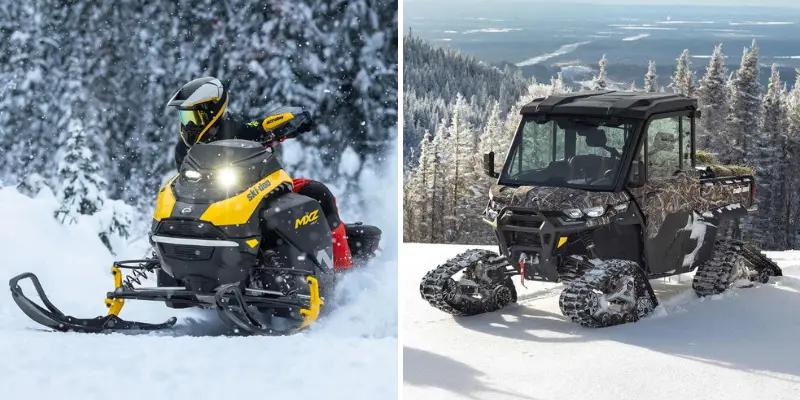
Expert guide on winterizing UTVs and preparing snowmobiles for Idaho winters. Learn about fuel stabilization, battery care, and suspension checks to protect your ride.
In the high desert of Eastern Oregon and the mountains of Idaho, winter isn’t just a season—it’s a stress test for machinery. Whether you are parking your Polaris Ranger after a long harvest season or pulling the tarp off your Ski-Doo Summit for a run up West Mountain, the cold is your equipment’s worst enemy.
At Edge Performance Sports in Ontario, we see the aftermath of neglected maintenance every spring: cracked engine blocks from frozen coolant, gummed-up injectors from bad fuel, and batteries that refuse to hold a charge. This guide is your insurance policy. We’ve compiled the definitive checklist to winterize your off-road vehicles and prep your sleds for the rugged conditions of the Pacific Northwest.
The Idaho Winter Reality: Why “Good Enough” Maintenance Fails Here
Temperatures in Ontario and Boise can swing from 40°F to -10°F in a matter of days. This thermal cycling wreaks havoc on seals, fluids, and batteries. “Winterizing” isn’t just about covering your machine; it’s about chemically and mechanically preparing it to survive dormancy or perform in sub-zero conditions.
Part 1: UTV Winterization – The “Store” vs. “Work” Decision
How you prep your UTV depends entirely on your plans: are you putting it away until the Danskin trails open in April, or are you strapping on a plow to clear the driveway?
How to Winterize Your UTV (Quick Guide)
To properly winterize a UTV for storage, follow these five steps:
- Stabilize Fuel: Add a fuel stabilizer to a full tank and run the engine for 15 minutes to prevent ethanol separation.
- Protect Battery: Remove the battery and connect it to a trickle charger indoors.
- Prevent Flat Spots: Jack up the vehicle to remove weight from the tires.
- Change Fluids: Replace oil and filter to remove contaminants.
- Seal It: Cover the vehicle and block exhaust/intake ports to prevent rodent nesting.
Scenario A: The Long Sleep (Storage Strategy)
If your UTV is hibernating, your goal is to prevent corrosion and flat spots.
- Fuel Stabilization is Non-Negotiable: Modern fuel contains ethanol, which is hygroscopic—meaning it absorbs moisture from the air. Over a long winter, this water separates and sinks to the bottom of your tank, corroding fuel pumps and injectors.
The Fix: Fill the tank to 95% capacity and add a high-quality fuel stabilizer like Polaris Carbon Clean. Run the engine for 15 minutes.
- The “Jack-Up” Technique: Leaving a UTV parked on concrete for months causes tires to develop permanent flat spots and puts unnecessary strain on the suspension.
The Fix: Place the vehicle on jack stands to take the weight off the tires.
- Battery Triage: A lead-acid battery left to discharge in freezing temps will suffer from sulfation.
The Fix: Remove the battery and store it in a temperature-controlled room connected to a smart trickle charger.
Don’t wake up to a dead ride. Shop our selection of NOCO Genius Smart Chargers in-store today.
Scenario B: The Winter Workhorse (Plowing & Tracks) If you are using your Can-Am Defender or Honda Pioneer for winter chores, the strategy shifts from “preservation” to “protection.”
- Coolant Flush: Ensure your coolant is rated for at least -30°F. If you’ve been topping off with water during summer, your mixture might be too diluted. A cracked block is a catastrophic failure.
- Viscosity Shift: Cold oil is thick oil. Switch to a lower viscosity synthetic oil (like 0W-40) to ensure immediate lubrication on cold starts.
- Cab Care: Lubricate door seals with silicone spray to prevent freezing shut. Check heater lines for kinks or leaks.
Part 2: Snowmobile Prep – Peak Season Performance Checklist
For our sled heads heading to McCall or Island Park, pre-season prep is a safety issue. A broken belt in the backcountry isn’t just an inconvenience; it’s a survival situation.
Snowmobile Pre-Season Checklist
Before the first ride, perform these critical checks:
- Hyfax (Slide Rails): Replace if worn near the indicator line.
- Carbides: Ensure steering runners are sharp for ice control.
- Drive Belt: Check for glazing/fraying and adjust deflection.
- Track Tension: Adjust sag to manufacturer specs (typically 1.25″-1.5″).
- Fluids: Top off injection oil (2-stroke) or check engine oil (4-stroke).
The “Point of Contact” Inspection: Hyfax & Carbides
Your slide rails (Hyfax) rely on snow for lubrication. Early season riding on thin snow or ice can melt these plastic strips rapidly. Inspect the wear indicator line on the side of the Hyfax. If it’s worn near the line, replace them immediately. It is much cheaper to replace a $40 strip of plastic than a $1,500 aluminum rail.
Not sure if your Hyfax is too worn? Bring your sled to our Ontario shop—we’ll measure it for free.
Belt Deflection & Track Tension
Does your sled squeal at idle or feel sluggish off the line? Your belt deflection is likely off. The drive belt should sit slightly above the secondary clutch sheaves. If it sits too low, your sled is essentially starting in “second gear,” causing bogging and excessive heat.
The “Do It Yourself” vs. “Service Dept” Decision Matrix
We love DIYers, but knowing when to tag in the experts can save you money in the long run.
| Maintenance Task | DIY Friendly? | Notes |
|---|---|---|
| Fuel Stabilizer | ✅ Yes | Pour, run, done. Easy. |
| Oil Change | ✅ Yes | Can be messy; ensure you have a filter wrench. |
| Hyfax Replacement | ⚠️ Moderate | Requires tools to loosen track and remove skid bolts. |
| Shock Rebuild | ❌ No | Requires nitrogen charging and specialized tools. |
| ECU Updates | ❌ No | Dealer-only digital wrench software required. |
Essential Winterization FAQ
Q: Can I just start my UTV once a month instead of winterizing it?
A: We don’t recommend it. Unless you run the machine long enough to reach full operating temperature (20+ minutes) and burn off internal condensation, short starts actually add moisture to the oil and exhaust, accelerating corrosion.
Q: Do I really need specific snowmobile oil?
A: Yes. Modern sled engines like the Rotax 850 E-TEC have tight tolerances. Generic oils may not flow correctly at -20°F or provide the necessary ash control for exhaust valves.
Q: When should I replace my snowmobile drive belt?
A: Inspect it for pulled cords, hourglassing (narrow spots), or glazing (shiny sides). If you see any of these, replace it. Always keep your old belt as a spare, but start the season with a fresh one.
Ready to Ride?
Whether you are putting your Ranger to bed or waking up your Summit, a few hours of maintenance now pays dividends all season. Don’t let a $20 part ruin a $20,000 investment.
Need a hand? Our certified technicians at Edge Performance Sports live and breathe this stuff. We can handle your winterization, pre-season inspections, and nitrogen shock rebuilds right here in Ontario.