
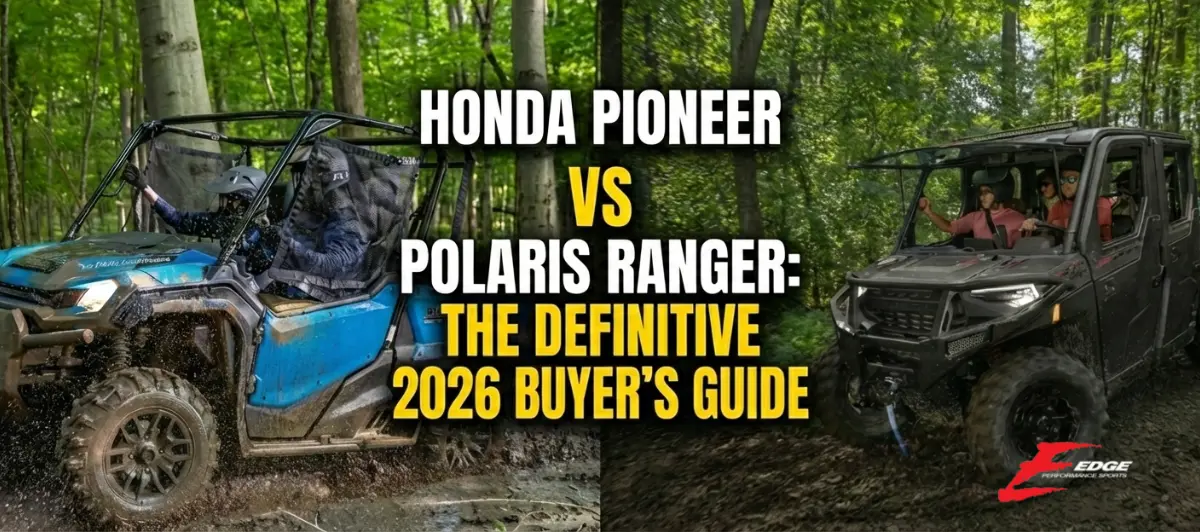
Honda Pioneer vs. Polaris Ranger: The Definitive 2026 Buyer’s Guide
A comprehensive engineering analysis of the two market leaders: DCT vs. CVT, NorthStar Comfort, and Long-Term Reliability.
📌 Guide Strategy Snapshot
The Core Choice: This isn’t just about specs; it’s about philosophy. Do you want automotive-grade mechanical durability (Honda) or industry-leading comfort and tech (Polaris)?
- 🚀 Best for Towing & Longevity: Honda Pioneer 1000 (DCT Transmission)
- 🛋️ Best for Comfort & Winter Work: Polaris Ranger XP 1000 (NorthStar HVAC)
- ⏱️ 2026 Update: Polaris has doubled service intervals to 2,000 miles; Honda has updated the Pioneer 700 and 520 lineups.
To truly understand the choice between a Honda Pioneer and a Polaris Ranger, one must look past the brochure specifications and examine the engineering ethos of the companies that build them. These two manufacturers represent diametrically opposed approaches to solving the same problem: moving people and gear across difficult terrain.
Chapter 1: The Philosophy of Engineering
The Great Transmission Divide: Gear-on-Gear vs. Variable Belt
The single most defining characteristic separating these two titans is the method of power transmission. This is not merely a technical detail; it is a philosophical line in the sand that determines driving feel, maintenance requirements, and reliability profiles.
Honda’s Automotive Approach (DCT): Honda views the UTV as an extension of its automotive lineage. Consequently, the Pioneer 1000 utilizes a 6-Speed Dual-Clutch Transmission (DCT). This is a fully geared transmission with steel gears and hydraulic clutches. It eliminates the “rubber band” feel of a CVT. When you press the gas, there is a direct, mechanical connection between the engine and the wheels. This philosophy prioritizes durability—steel does not stretch or snap under heat like rubber.
Polaris’s Heritage (CVT): Polaris traces its roots to snowmobiles, where the Continuously Variable Transmission (CVT) was perfected. Their philosophy favors the CVT for its ability to keep the engine at peak power RPM regardless of vehicle speed. This prioritizes smoothness. A CVT smoothens out driver inputs, making it easy to drive slowly over technical terrain without “shift shock.” However, it introduces a wear item—the drive belt.
Market Positioning
- Honda (Rec/Utility): Targeted at the pragmatist. Buyers who value “Honda Reliability” and expect the machine to start on the first crank 10 years from now.
- Polaris (Hardest Working, Smoothest Riding): Targeted at the innovator. Buyers who treat their UTV as a mobile office and value features like HVAC, Ride Command, and plush suspension.
Chapter 2: Powertrain & Drivetrain Technology
Engine Performance Dynamics
Honda Pioneer 1000: The 999cc Unicam® parallel-twin delivers torque instantly off idle. Because there is no belt slip, throttle response is immediate. This is excellent for experienced drivers who want precise control for towing, though it can feel “snatchy” to novices.
Polaris Ranger XP 1000: The ProStar 999cc DOHC twin feels smoother. The CVT acts as a buffer, allowing the engine to rev to its power peak while the vehicle accelerates linearly. This makes the Ranger feel less aggressive but often easier to manage when towing delicate loads.
💡 Edge Pro Tip: The Towing Factor
If you tow heavy trailers across the Owyhee mountains, the Honda’s direct gear drive provides superior engine braking and is virtually indestructible. If your priority is a smooth ride for property maintenance, the Polaris CVT is unmatched.
Traction Systems: i-4WD vs. True On-Demand AWD
Honda i-4WD: Uses a Brake Traction Control system. It pulses the brake on a spinning front wheel to force power to the wheel with grip. It allows for light steering but is reactive (requires some wheel spin to engage).
Polaris On-Demand AWD: A mechanical system that locks both front wheels when the rear wheels slip. It provides a true mechanical lock for maximum traction but can increase steering effort when engaged.
Chapter 3: Chassis, Suspension, & Handling
Suspension Geometry & Self-Leveling
The Honda Pioneer 1000-5 Deluxe features load-leveling rear suspension. These shocks pump themselves up using the energy from the suspension’s movement to maintain ride height and headlight aim even when the bed is loaded with 1,000 lbs of gravel.
The Polaris Ranger XP 1000 is universally praised for its “magic carpet” ride. It utilizes softer spring rates and bushings to float over washboards and ruts that would jar the teeth of a Pioneer driver.
Chapter 4: Detailed Model Comparisons
| Category | Honda Pioneer 1000-5 | Polaris Ranger XP 1000 |
|---|---|---|
| Transmission | 6-Speed DCT (Gears) | PVT (Belt-Driven) |
| Seating | QuickFlip® (Convertible Bed) | Fixed Bench (3 or 6 Passenger) |
| Turning Radius | ~13.8 ft (Agile) | Larger (Due to longer wheelbase) |
| Ground Clearance | 12.8″ – 13.6″ | 13.0″ – 14.0″ (Arched A-Arms) |
| Best For | Durability / Technical Trails | Comfort / Mud / Winter |
The “QuickFlip” Magic vs. The Crew Cab
Honda’s unique QuickFlip® seating allows the Pioneer 1000-5 to convert from a 3-seater with a full bed to a 5-seater by flipping up seats from the bed floor. This keeps the wheelbase short and agile. The downside? You lose cargo space when passengers are in the back.
Polaris requires you to step up to the Ranger Crew to carry passengers. This results in a massive vehicle that is harder to turn in tight woods but offers full comfort and full cargo capacity simultaneously.
Chapter 5: Cabin Experience & Technology
The NorthStar Advantage
If you need climate control, Polaris wins. The Ranger NorthStar Edition features a factory-installed HVAC system with variable compressor A/C and heat. It is a fully sealed automotive environment.
Honda does not offer a factory-integrated equivalent. While dealer-installed heaters and cabs are available, they rarely match the seal and quietness of the factory Polaris unit.
Ride Command
Polaris offers Ride Command, a 7-inch touchscreen with GPS, waypoints, and Group Ride tracking that works without cell service. Honda relies on a standard digital instrument cluster.
Chapter 6: Reliability & Maintenance
Common Issues
- Honda: Early models had cabin heat issues (improved in 2022+). The DCT is robust but relies on complex electronics that don’t like being submerged in deep water without proper waterproofing.
- Polaris: Drive belts are a wear item. Heavy towing in High gear can burn a belt. However, the 2026 models feature extended service intervals (2,000 miles), significantly lowering the cost of ownership.
Chapter 7: Conclusion & Recommendations
- Choose Honda Pioneer If: You value mechanical connection, hate changing belts, need a machine for steep terrain engine braking, or need the versatility of a short wheelbase that can carry 5 people.
- Choose Polaris Ranger If: You value comfort above all, need a factory climate-controlled cab (NorthStar), love integrated technology like GPS, or need to carry a 6-person crew AND cargo simultaneously.
Ready to feel the difference? Test drive the DCT vs. CVT at Edge Performance Sports today.