
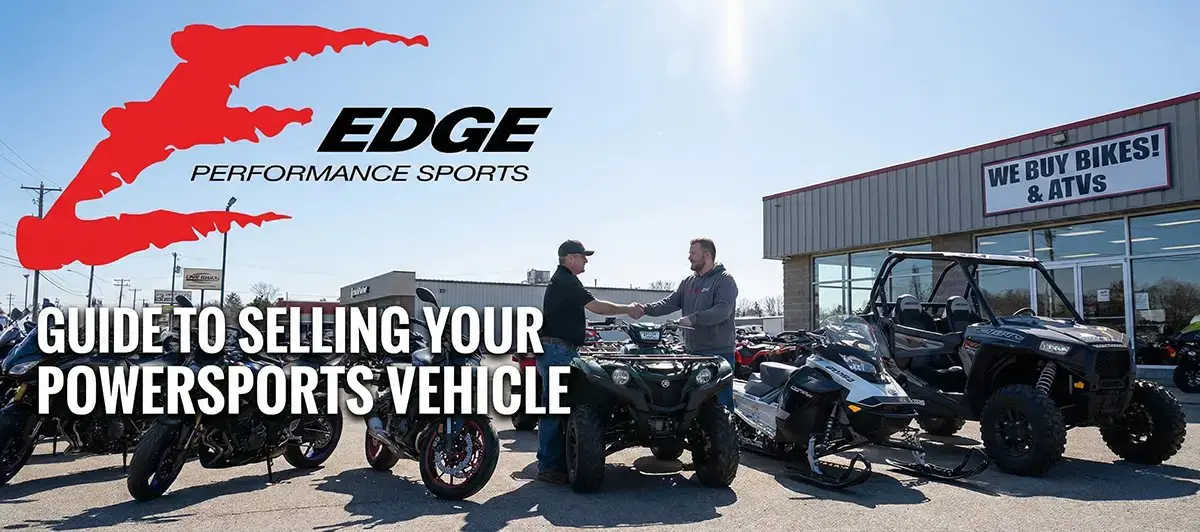
The Ultimate Guide to Selling Your Powersports Vehicle: Dealer Trade-In vs. Private Sale
Do you trade it in for convenience and tax savings, or brave the private market for top dollar? Here is the math every Pacific Northwest rider needs to know.
Every powersports enthusiast eventually arrives at the same crossroads. You are eyeing the new lineup in the showroom—perhaps the latest turbocharged Polaris RZR, a track-ready Honda CBR, or a Ski-Doo Summit built for deep powder. But standing between you and that new machine is your current vehicle.
The question is as old as the industry itself: Do you trade it in at the dealership, or do you sell it yourself on the private market?
For riders in the Treasure Valley, this is not just a question of convenience; it is a complex calculation involving tax codes, state lines, market seasonality, and risk tolerance. A cursory glance at online forums might convince you that “private sale is king,” but when you peel back the layers of sales tax credits, reconditioning costs, and liability, the math often tells a different story.
What is the Idaho Powersports Trade-In Tax Credit?
The Idaho Trade-In Tax Credit allows residents to deduct the value of a traded-in vehicle from the taxable purchase price of a new vehicle. For example, if you buy a $20,000 UTV and trade in a vehicle worth $12,000, you only pay Idaho’s 6% sales tax on the $8,000 difference. This saves you $720 in taxes—savings you lose if you sell privately.
1. The Economics of Value: Wholesale vs. Retail
To understand the trade-in offer, one must first understand the powersports supply chain. The most common source of friction is the gap between the “Retail” price a seller sees online and the “Wholesale” offer the dealer presents.
The Three Books: KBB, NADA, and Black Book
Sellers typically arm themselves with consumer data, but the industry operates on three distinct sets of books:
| Valuation Guide | Data Source | Typical Value |
|---|---|---|
| Kelley Blue Book (KBB) | Asking Prices | Highest. Often reflects what sellers hope to get, not actual sale prices. |
| NADA Guides | Historic Algorithms | Moderate. Used by banks for lending limits. Assumes “perfect” condition. |
| Black Book / NPA | Auction Transaction Data | Lowest (True Market). Reflects cash value at wholesale auctions today. |
The “Reconditioning Fee” Reality
When a dealer takes in a trade, they cannot simply wash it and put it on the floor. A private seller can list a bike with worn tires and say “needs rubber.” A dealer cannot. We must replace tires, flush fluids, and fix cosmetic defects to meet safety standards. If a bike needs $1,200 in work, that cost comes directly off the trade value.
2. Option A: The Dealer Trade-In Advantage
Trading in is the path of convenience, security, and tax efficiency. For many riders, the “on paper” loss in gross value is entirely recouped through tax savings.
💰 The Tax Savings Calculator (Example)
Imagine you are buying a new $25,000 Can-Am Defender.
- Scenario A (No Trade): You pay 6% tax on $25,000.
Tax Bill: $1,500 - Scenario B (Trade-In): You trade in your old ATV for $15,000. Taxable amount is now only $10,000.
Tax Bill: $600
The Verdict: The trade-in saved you $900 in cash. To beat the dealer’s offer in a private sale, you would have to sell your ATV for more than $15,900 to break even.
Lien Payoffs Made Easy
Trading in a vehicle with an active loan is seamless at a dealership. We contact your bank, obtain the 10-day payoff, and cut the check. If you have negative equity (owe more than it’s worth), we can often roll that difference into your new loan—something impossible to do in a private sale.
3. Option B: The Private Sale Masterclass
If you own your vehicle outright and have plenty of time, selling privately can yield the highest gross return. However, you are paying yourself to do the job of the dealership.
The “No Cash, No Ride” Rule
The universal rule of private sales is strictly enforcing test rides. If a buyer crashes your bike during a test ride, your insurance is on the hook. Always demand the full asking price in cash in your hand before the engine starts.
Beware of Title Jumping
What is Title Jumping?
“Title jumping” is the illegal act of selling a vehicle without registering it in your name to avoid taxes. If you buy a bike where the seller’s name doesn’t match the title, the DMV may refuse to transfer ownership, leaving you with a vehicle you legally cannot ride.
4. Navigating the Idaho-Oregon Border
Living in the Treasure Valley means navigating two tax systems. A common myth is that Idaho residents can buy in Oregon to avoid tax. This is false.
- The Law: When you register the vehicle in Idaho, you will be assessed “Use Tax” (6%) on the purchase price.
- The Good News: Idaho recognizes the trade-in tax credit even if you buy from an Oregon dealer like Edge Performance Sports. We document the trade on the bill of sale so you get your full tax deduction at the Idaho DMV.
Summary: Comparison Matrix
| Feature | Dealer Trade-In | Private Sale |
|---|---|---|
| Net Sale Price | Enhanced by Tax Credit | Reduced by haggling & prep costs |
| Time to Sell | Immediate (1 Hour) | Weeks or Months |
| Safety Risk | Zero | Moderate (Theft/Scams) |
| Lien Payoff | Seamless (Dealer handles) | High Friction (Bank visits) |