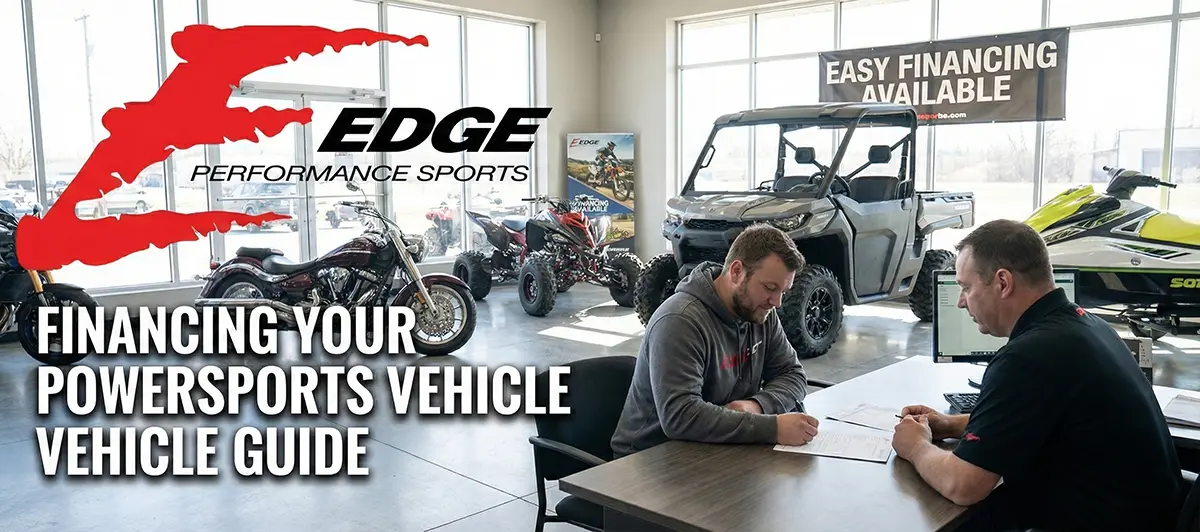
The Ultimate Guide to Financing Your Powersports Vehicle: Dealership vs. Bank
Stop dreaming and start riding. Here is everything you need to know about securing the best loan for your Motorcycle, ATV, or UTV.
🚀 Guide Strategy Snapshot (TL;DR)
- The Core Choice: You can finance through a local bank/credit union or directly through the dealership.
- The Dealer Edge: Dealerships offer “OEM Incentives” (lower rates from manufacturers) and allow you to bundle gear and parts into your monthly payment.
- Credit Matters: While better credit yields lower rates, specialized powersports lenders often have programs for challenging credit situations.
- Action Plan: Getting pre-approved helps you set a realistic budget before you fall in love with a specific machine.
There is nothing quite like the feeling of walking into a showroom and spotting the machine you’ve been dreaming about. Whether it’s a sleek sportbike, a rugged ATV for the farm, or a high-performance UTV for the dunes, the excitement is palpable.
Then, the reality sets in: How am I going to pay for this?
For most buyers, dropping $10,000 to $30,000 in cash isn’t feasible—or smart. Financing allows you to break that large purchase into manageable monthly payments, keeping your cash reserves safe for other needs. But not all loans are created equal. In this comprehensive guide, we will break down the differences between dealership financing and bank loans, explain OEM promotions, and help you navigate the credit process with confidence.
What is the difference between powersports financing and an auto loan?
While similar, powersports loans are categorized as “recreational loans.” They often have slightly different interest rate structures and term lengths compared to auto loans. Importantly, powersports loans often allow for accessory inclusion—meaning you can finance your helmet, winch, plow, or riding gear along with the vehicle.
Understanding Your Financing Options
When you decide to finance, you generally have three avenues. Understanding the pros and cons of each is vital to saving money over the life of your loan.
1. Dealership Financing (The Specialized Route)
This is the most common method for a reason. Dealerships work directly with large lending networks (like Sheffield Financial, Synchrony, or FreedomRoad) that specialize in toys. They understand that an ATV isn’t just a car with four wheels.
2. Local Banks & Credit Unions
If you have a long-standing relationship with a local credit union, they may offer you a personal loan or a recreational vehicle loan. These can be competitive, but they often lack the flexibility of dealer financing regarding incentives.
3. OEM Financing (Manufacturer Promotions)
This is the “Secret Weapon” of dealership financing. Manufacturers like Honda, Polaris, Can-Am, and Kawasaki often subsidize interest rates to sell units. You might see offers for 0% APR for 12 months or significantly reduced rates that local banks simply cannot match because they don’t have a vested interest in selling the vehicle.
Dealership vs. Bank: Head-to-Head Comparison
Why do most riders choose to finance at the dealership where they buy the vehicle? It usually comes down to convenience and the “Bundle Factor.”
| Feature | Dealership Financing | Bank / Credit Union |
|---|---|---|
| Convenience | High (One-stop shop) | Medium (Requires separate trips/calls) |
| Interest Rates | Access to OEM promos (0-3.99% possible) | Standard market rates (often higher for toys) |
| Bundling Gear/Parts | YES (Helmets, plows, warranties included) | NO (Usually vehicle only) |
| Credit Flexibility | High (Multiple lenders to choose from) | Strict (Pass/Fail criteria) |
| Down Payment | Flexible (Sometimes $0 down promos) | Usually required (10-20%) |
Imagine buying a $15,000 UTV. You also need a roof, a windshield, a winch, and two helmets. That could cost an extra $2,500. At a bank, you’d have to pay that $2,500 out of pocket immediately. At a dealership, that $2,500 adds roughly $40 to your monthly payment.
How Credit Scores Impact Your Ride
A common myth is that you need perfect credit to buy a motorcycle or ATV. While a score of 720+ unlocks the best OEM promotions, many lenders specialize in “Tier 2” or “Tier 3” credit.
Can I finance with bad credit?
Yes, but with caveats. Dealerships have relationships with “second-chance” lenders. If your credit is less than perfect, be prepared for:
- A higher interest rate.
- A required down payment (usually 10% to 20%).
- Income verification (bringing in pay stubs).
Financing a smaller, more affordable bike is often a great way to rebuild your credit score by making on-time payments.
Step-by-Step: How to Finance Your Vehicle
Determine Your Monthly Budget
Don’t just look at the price tag ($12,000). Look at the monthly commitment. A general rule of thumb for powersports is roughly $20-$25 per month for every $1,000 financed (depending on terms/rates).
Get Pre-Approved Online
Save time at the dealership. Filling out a pre-approval form allows the finance team to shop for the best rate before you even walk in the door.
Gather Your Documents
To speed things up, bring a valid driver’s license, proof of insurance (or be ready to get it), and potentially proof of income if your credit file is thin.