Published by: Edge Performance Sports (Ontario, OR)
Reading Time: 8 Minutes
Focus: 2025 Model Year Updates, Technical Engineering Comparisons, and Regional Trail Application.
The landscape of All-Terrain Vehicles (ATVs) has shifted dramatically as we enter the 2025-2026 model years. For riders in the Treasure Valley—from the onion fields of Nyssa to the rocky ascents of the Owyhee Front—the choices have never been more distinct. The market has bifurcated into two clear philosophies: the “Smart-Tech” innovators who are integrating GPS and ride modes into the chassis, and the “Mechanical Purists” who are doubling down on gear-driven durability.
At Edge Performance Sports, we understand that buying an ATV in Eastern Oregon or Western Idaho isn’t just a recreational purchase; often, it’s a necessary tool for land management, hunting access, and winter snow removal. This comprehensive guide analyzes the six major players—Polaris, Honda, Can-Am, Suzuki, Kawasaki, and CFMOTO—to help you identify exactly which machine matches your terrain and task list.
Best for: Riders who demand connectivity, premium features standard, and high-value performance.
Models to Watch: Sportsman 570 Ultimate, Sportsman XP 1000
Polaris continues to hold the crown for technological integration. The defining feature for the 2025/2026 lineup is the expansion of RIDE COMMAND.
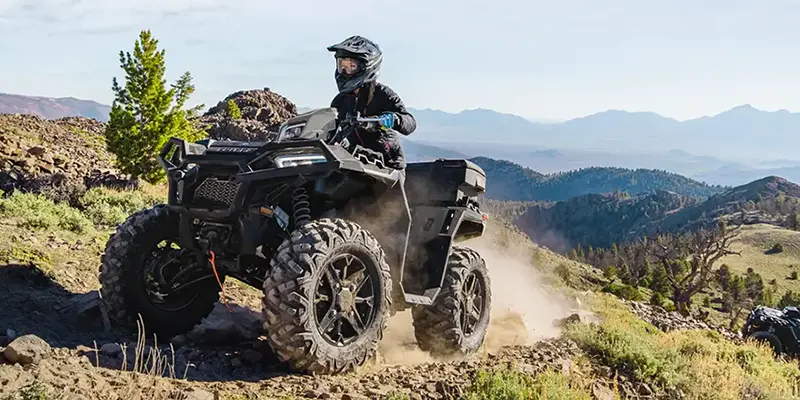
| Towing Capacity | 1,350 lbs (612 kg) via standard 1.25″ receiver |
| Horsepower | 44 HP (ProStar 570 engine) |
| Ground Clearance | 11.5 inches |
| Drive System | One-Touch On-Demand AWD (engages automatically when rear wheels slip) |
Models to Watch: CFORCE 600 Touring, CFORCE 1000 Touring (Gen 3)
If you haven’t looked at CFMOTO lately, you are looking at the past. The new Gen 3 CFORCE platform has fundamentally changed the value equation in the ATV market.
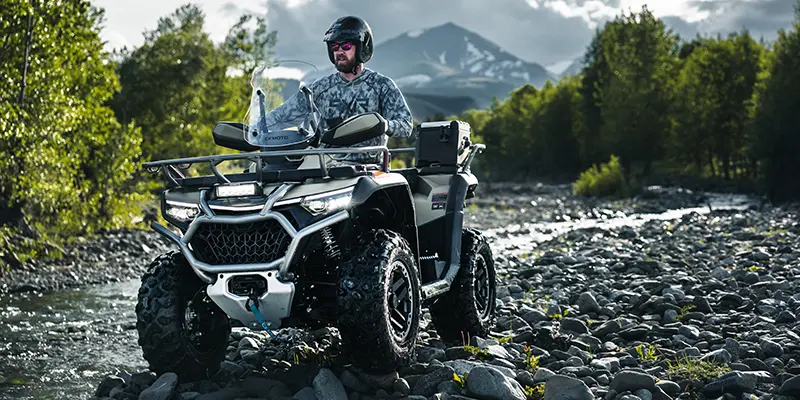
| Towing Capacity | 1,800 lbs (Class-leading) |
| Winch | 3,500 lb synthetic rope (Standard) |
| Shocks | Fully adjustable gas reservoir shocks (Compression/Rebound) |
Best for: Agricultural work, fleet use, and riders who prioritize longevity over peak horsepower.
Models to Watch: Rubicon 700 (New for 2025), Foreman 520
Honda stands alone in the industry by largely rejecting the belt-driven CVT (Continuously Variable Transmission) for their utility line. This philosophy resonates deeply with our agricultural customers in Vale and Weiser.
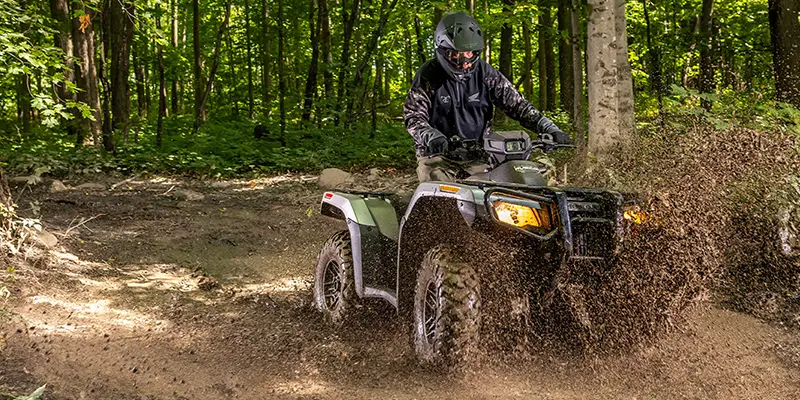
| Transmission | 3-Speed Automatic with Torque Converter (No Belt) |
| Engine Orientation | Longitudinal (Crankshaft runs front-to-back for direct driveshaft alignment) |
| Rear Suspension | Independent Dual-Arm (IRS) for ride comfort |
Models to Watch: KingQuad 750 AXi, KingQuad 500 AXi
In the high desert of Oregon and Idaho, dust is the enemy. It grinds brake pads and clogs filters. Suzuki has engineered the KingQuad specifically to defeat this environment.
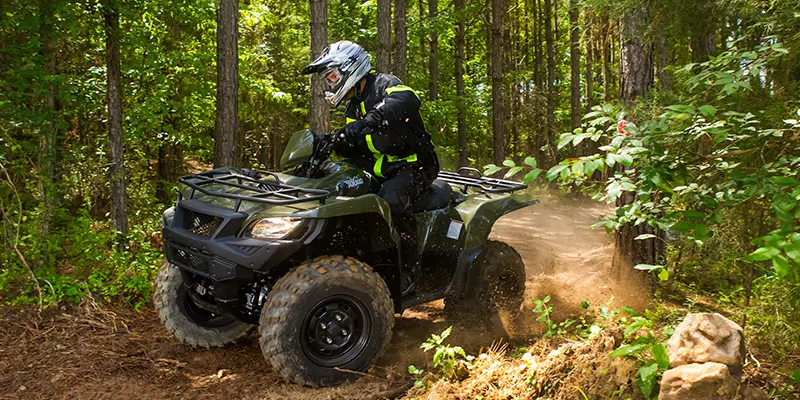
| Braking | Sealed Oil-Bathed Multi-Disc (Rear) |
| Towing | 1,322 lbs (Receiver Style Hitch) |
| Diff Lock | Push-button selectable front differential lock |
Best for: Riders who want adrenaline, heavy hauling capability, and aggressive styling.
Models to Watch: Outlander 700 / PRO HD7
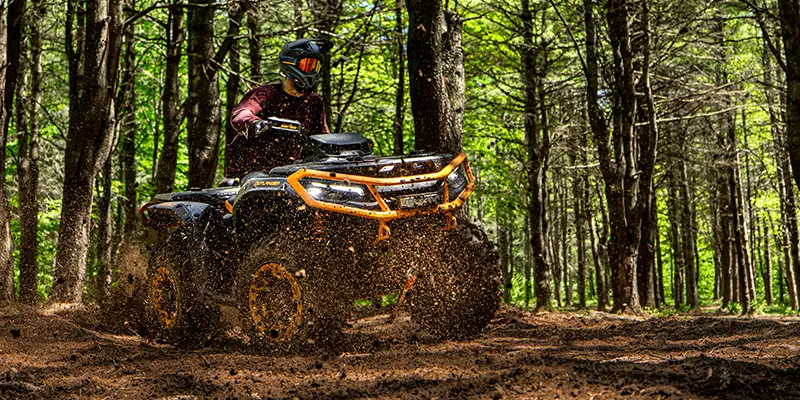
Can-Am re-engineered their mid-cc class for 2025/2026, creating the Outlander 500 and 700. These are not “small” quads; they are full-sized chassis machines powered by the Rotax ACE single-cylinder engine.
| Power | 50 HP / 41 lb-ft Torque |
| Towing | 1,830 lbs (Best-in-class) |
| Transmission | pDrive primary CVT (Roller design for instant engagement and durability) |
Models to Watch: Brute Force 750 4x4i
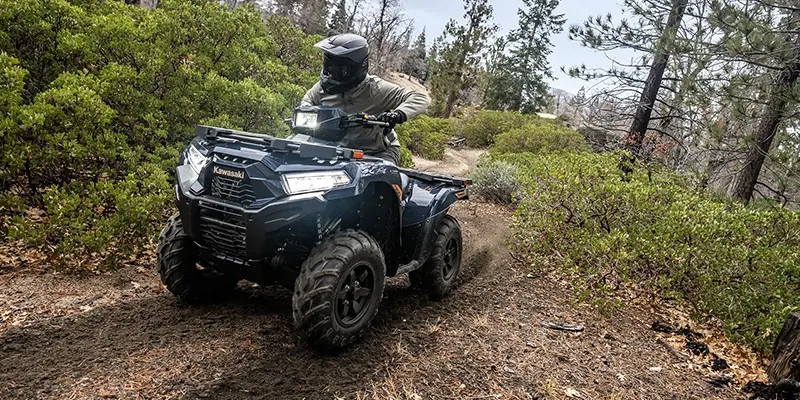
Kawasaki has updated the legendary Brute Force 750 for 2025, keeping the soul of the machine while modernizing the interface.
To help you decide, we have mapped these vehicles to the specific riding areas around Ontario and Boise.
| Riding Area | Terrain Type | Recommended Machine | Why? |
|---|---|---|---|
| Owyhee Front (Hemingway Butte) | Steep rocky climbs, deep silt (“moon dust”), technical ruts. | Kawasaki Brute Force 750 or Can-Am Outlander XT | You need instant torque to pop over rock steps (Kawasaki) and high ground clearance (Can-Am offers 12″+) to avoid high-centering in deep ruts. |
| Succor Creek / Leslie Gulch | Long, fast gravel roads with severe washboard bumps. | Polaris Sportsman 570/1000 | The Polaris Independent Rear Suspension (IRS) is widely regarded as the plushiest in the industry, soaking up washboard vibrations better than stiffer utility quads. |
| Agricultural Fields (Nyssa/Vale) | Mud, heavy towing, start-stop operation. | Honda Rubicon 700 or Suzuki KingQuad | The Honda’s lack of a belt makes it immune to burning up during slow-speed spraying. The Suzuki’s sealed brakes are immune to the alkali dust and mud of the fields. |
| Danskin Mountains | Tight, winding forest trails with width restrictions. | Honda Rancher 420 DCT | Its narrower chassis and DCT transmission make it nimble in the trees, and the gear selection gives you total control on steep, loose descents. |
Designed to answer your most pressing questions directly.
Oregon has no state sales tax. However, Idaho residents are required to pay Idaho use tax when they register the vehicle in Idaho. Our finance team handles cross-border transactions daily and can help you structure your financing to include estimated tax and title fees for a seamless registration process in your home state.
Yes. We accept trade-ins on all major powersports vehicles, including dirt bikes, street bikes, UTVs, and other ATVs. We use real-time market data to give you a fair trade-in value that you can apply directly to your new purchase.
For heavy, low-speed towing (like a harrow or sprayer), a shaft-drive with a geared transmission (like the Honda Foreman/Rubicon) is superior because there is no drive belt to slip or burn. However, modern CVTs (like in the Can-Am Outlander PRO or CFMOTO CFORCE) are rated for very high loads if used in “Low Gear.” If you tow heavy, always use Low Gear to protect the belt.
The standard factory interval might say 100 hours, but in the fine “moon dust” of the Owyhees, we recommend checking your air filter after every single ride. A clogged filter can destroy an engine in minutes. For oil changes, stick to the manufacturer’s schedule, but consider doing it more frequently if you do short trips where the engine doesn’t reach full operating temperature (which can cause condensation buildup).
The Dual Clutch Transmission (DCT) found on the Honda Rancher and Foreman Rubicon offers the best of both worlds. It gives you the durability of steel gears (no belts) but the convenience of automatic shifting. You can let the computer shift for you, or use the handlebar buttons to shift manually, giving you total control for engine braking on steep downhills.
The 2025 lineup is the most diverse and capable we have ever seen. Whether you need the brute strength of a Can-Am Outlander PRO for your ranch, the tech-savvy navigation of a Polaris Sportsman for deep exploration, or the bulletproof reliability of a Honda or Suzuki for decades of service, Edge Performance Sports has the inventory and the expertise to get you on the right machine.
Visit Us Today:
📍 1625 N Oregon St, Ontario, OR 97914
📞 Sales: 541-903-5438
©2026. Edge Performance Sports. All Rights Reserved.

While great effort is made to ensure the accuracy of the information on this site, errors can occur. Please verify all pricing and installed equipment information with a customer service representative. This is easily done by calling us or visiting us at the dealership.
We improve our products and advertising by using Microsoft Clarity to see how you use our website. By using our site, you agree that we and Microsoft can collect and use this data. Our privacy statement has more details.
Save your favorite vehicles for later viewing on your desktop or mobile devices.
Keep track of all the vehicles you've viewed for a better car shopping experience.
Narrow your search by comparing your favorite vehicles.