
- Sales:541-903-5438
- |
- Service:541-204-2095
- |
- Parts:541-204-2114
If you’ve been researching middleweight sportbikes, you’ve likely come across the Yamaha YZF-R7 and the Kawasaki Ninja ZX-6R. On paper, they look similar—aggressive styling, sportbike ergonomics, and lightweight designs.
However, once you break down the specs and real-world performance, these two machines serve very different riders. While the R7 is often compared to the Kawasaki Ninja 650 due to its engine configuration, the Ninja ZX-6R represents a massive step up in power, technology, and track-ready capability.
At Edge Performance Sports in Ontario, Oregon, we specialize in high-performance machines like the Kawasaki ZX-6R—and this comparison explains why many riders choose to step up to the Green Team.
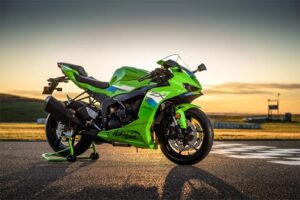
The most significant difference lies under the fairings. The Yamaha R7 uses a “Crossplane” parallel-twin, while the Ninja ZX-6R utilizes a high-revving inline-four engine.
| Feature | Yamaha R7 | Kawasaki Ninja ZX-6R |
| Engine Type | 689cc Parallel-Twin | 636cc Inline 4-Cylinder |
| Horsepower | ~74 hp | 127 hp @ 13,000 rpm |
| Torque | 49.4 lb-ft | 52.1 lb-ft |
| Power Delivery | Torquey, low-end focus | High-revving supersport scream |
What This Means:
The R7 is built for accessibility and predictable street riding. The ZX-6R, however, delivers a massive jump in top-end speed and nearly double the horsepower. If you are looking for adrenaline and serious performance, the Kawasaki is the undisputed winner.
Modern sportbikes are defined by their electronics. Kawasaki has integrated “trickle-down” technology from their racing programs into the ZX-6R.
Yamaha R7: Features standard ABS and an optional quickshifter. It utilizes a basic LCD display and lacks adjustable power modes.
Kawasaki Ninja ZX-6R: Comes standard with the Kawasaki Intelligent Braking System (KIBS), 3-Mode Traction Control (KTRC), and Power Modes (Full/Low). It also features a standard Kawasaki Quick Shifter (KQS) for clutchless upshifts.
What This Means:
The ZX-6R gives riders more control and confidence—especially when pushing the bike harder or riding in variable conditions. The 4.3” TFT color display on the Kawasaki also offers smartphone connectivity via the RIDEOLOGY THE APP, allowing you to track vehicle info and riding logs.
Yamaha R7: Uses a balanced, forgiving setup that works well for daily commutes and casual canyon carving.
Kawasaki Ninja ZX-6R: Features the Showa SFF-BP (Separate Function Fork – Big Piston). This is a fully adjustable, track-focused suspension system designed for precision, high-speed stability, and aggressive cornering.
At higher speeds, braking performance becomes a safety essential.
The Yamaha R7 uses dual discs with standard ABS.
The Kawasaki ZX-6R features massive 310mm dual discs paired with radial-mounted monobloc calipers. Combined with the KIBS (Intelligent ABS), the Kawasaki offers stronger, more precise stopping power with better lever feel.
The Yamaha R7 is a solid entry-to-mid-level bike, but for riders who want more than just a “starter” feel, the Kawasaki Ninja ZX-6R is the better long-term investment. It offers:
Significantly more horsepower for growth and excitement.
Advanced rider technology for safety and performance tuning.
Superior suspension and braking for track and technical road riding.
Pro-Tip: If you love the slim feel of a parallel-twin but want the reliability and support of the Kawasaki brand, ask us about the Ninja 650. But if you want the high-revving power of a true 600-class supersport, the ZX-6R is the king of the middleweights.
While we don’t carry Yamaha models, we stock a full range of high-performance Kawasaki sportbikes right here in Ontario, Oregon. Serving the Treasure Valley and beyond, our team can help you walk through features, rider fitment, and find the right bike for your goals.
©2026. Edge Performance Sports. All Rights Reserved.

While great effort is made to ensure the accuracy of the information on this site, errors can occur. Please verify all pricing and installed equipment information with a customer service representative. This is easily done by calling us or visiting us at the dealership.
We improve our products and advertising by using Microsoft Clarity to see how you use our website. By using our site, you agree that we and Microsoft can collect and use this data. Our privacy statement has more details.
Save your favorite vehicles for later viewing on your desktop or mobile devices.
Keep track of all the vehicles you've viewed for a better car shopping experience.
Narrow your search by comparing your favorite vehicles.