
- Sales:541-903-5438
- |
- Service:541-204-2095
- |
- Parts:541-204-2114
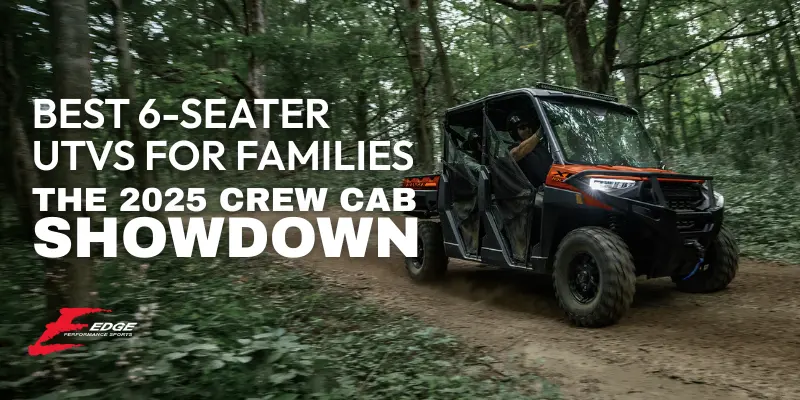
For families in Idaho and Oregon, the days of taking two separate vehicles to the trailhead are officially over. The modern 6-seater UTV (often called a “Crew” or “MAX” model) has evolved from a clumsy job-site people mover into a high-performance adventure machine capable of tackling the toughest terrain the Pacific Northwest has to offer.
Whether you are exploring the vast high desert of the Owyhees, navigating the dense timber near McCall, or cruising the dunes at St. Anthony, a 6-passenger side-by-side allows the whole family to ride together in a single vehicle. This shared experience is what powersports is all about—connectivity, adrenaline, and accessing places a standard truck simply cannot reach.
At Edge Performance Sports, serving Boise, Ontario, and the surrounding treasure valley, we have seen a massive shift in buyer demand. Riders no longer want just “utility”; they want “utility plus comfort.” They need machines that can haul hay on Friday and haul the kids to the lake on Saturday. Drawing on industry trends, customer feedback, and deep performance metrics, we are diving deep into the top 6-seater options for 2025.
A common question we get at the dealership is, “Should I buy one 6-seater or two 2-seaters?” While two machines offer autonomy, the 6-seater “Crew” chassis offers distinct advantages that go beyond just saving money on a second trailer:
| Model | Engine Class | Seating Style | Best For |
|---|---|---|---|
| Polaris Ranger Crew XP 1000 | 999cc Twin (82 HP) | Plush Bench | Comfort & Ride Quality |
| Can-Am Defender MAX | HD9 / HD10 (65-82 HP) | Versatile Bench | Utility, Torque & Storage |
| Honda Pioneer 1000-6 | 999cc Twin (DCT) | Full-Size Rear | Reliability & Rear Legroom |
| Kawasaki Mule PRO-FXT 1000 | 999cc Twin | Trans-Cab™ | Flexibility (3 to 6 Passenger) |
As noted in recent performance analyses of 6-seater UTVs, manufacturers have had to overcome the significant challenge of balancing weight with ride quality. A fully loaded 6-passenger machine can weigh over 2,500 lbs before passengers are even added. Modern engineering has solved the “heavy haul” sluggishness through several key innovations.
The biggest hurdle for 6-seaters is suspension sag. If you spring it stiff enough for 6 adults, it rides like a brick when you are driving alone. Top-tier brands have addressed this with self-leveling rear suspension (found on the Honda Pioneer) or progressive rate springs (found on Can-Am and Polaris). These systems allow the initial travel to be soft for small bumps, while the deeper travel stiffens up to prevent bottoming out when fully loaded.
Dealing with engine noise is critical when six people are trying to talk. Brands like Polaris and Can-Am have utilized advanced insulation materials and rear-mounted engines to keep the cabin quieter. The Polaris Ranger, for instance, uses a one-piece chassis design that reduces squeaks and rattles, a major factor in perceived quality during long trail days.
The Ranger Crew XP 1000 remains the benchmark for comfort in the industry. Polaris focuses heavily on the “living room on wheels” concept, and it shows in the fit and finish.
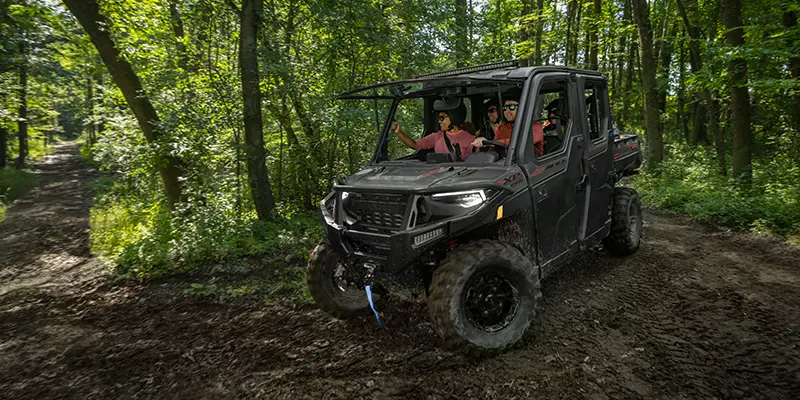
Living in Idaho means dealing with dusty summers and freezing winters. The Ranger Crew XP 1000 NorthStar Edition is the gold standard for climate control. This isn’t just a heater slapped under the dash; it is a fully sealed factory cab with automotive-grade air conditioning, heat, and defrost. For families, this means no more complaining about dust in eyes or freezing fingers during late-season elk hunts.
Polaris also leads the tech race with their Ride Command system. This 7-inch glove-touch display features built-in GPS that tracks your ride without needing cell service—a lifesaver in the remote Owyhee mountains. It also features Group Ride, which allows you to see other Ride Command-equipped vehicles on the map, ensuring no one in your convoy gets lost.
If your family adventures involve towing a boat to the ramp or hauling heavy camping gear for a week in the woods, the Can-Am Defender MAX is the powerhouse you need. Powered by the Rotax HD10 engine, it produces 82 horsepower and a class-leading 69 lb-ft of torque.
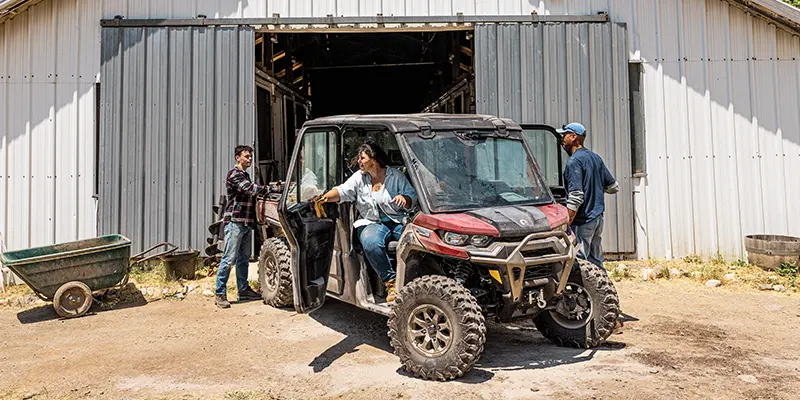
Can-Am understands that 6 passengers come with a lot of gear. The Defender MAX excels in interior storage, offering a dual-level dashboard and a removable toolbox. But the real winner is the flip-up passenger seats. The rear seats flip up against the back wall, allowing you to store bulky items—like large coolers, hunting dogs, or dry bags—inside the waterproof cab rather than tossing them loosely in the bed.
For technical terrain, Can-Am’s Smart-Lok front differential is a game changer. It offers specific modes like “Trail” and “Mud” that automatically lock the front differential when slip is detected, pulling the long chassis through mud holes that would leave lesser machines stranded.
Honda entered the 6-seater game later than the others, but they did so with a specific goal: fixing the rear seat cramping. On many competitor models, the rear wheel well intrudes into the rear cabin, forcing passengers to sit with their knees angled awkwardly.
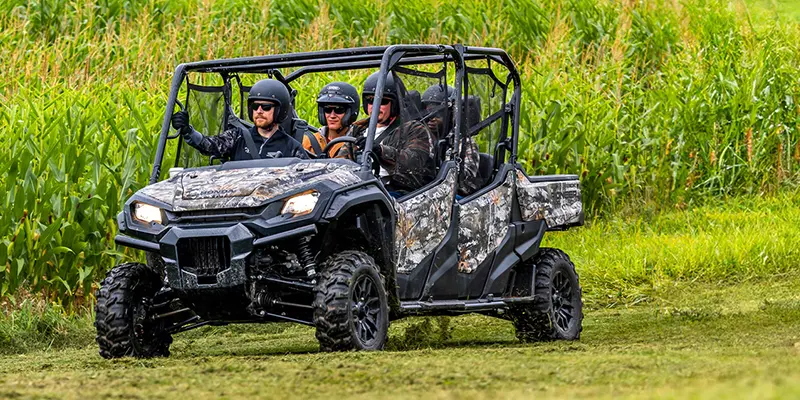
The Honda Pioneer 1000-6 features a full-width rear bench that pushes the rear wheels further back, ensuring full-sized adults fit comfortably in the second row with massive legroom.
Unlike the belt-driven CVT transmissions found in Polaris and Can-Am, the Honda utilizes a Dual Clutch Transmission (DCT). This is an actual geared transmission with no belt to burn. For riders who tackle steep, technical descents in the Sawtooths, the engine braking provided by the DCT is superior, giving a direct, connected feel to the ground that belt drives sometimes lack.

We cannot discuss 6-seaters without mentioning the legend of versatility: the Kawasaki Mule PRO-FXT 1000. While the “Mule” name traditionally implies slow-speed farm work, the new 1000cc engines have given this machine serious trail capability.
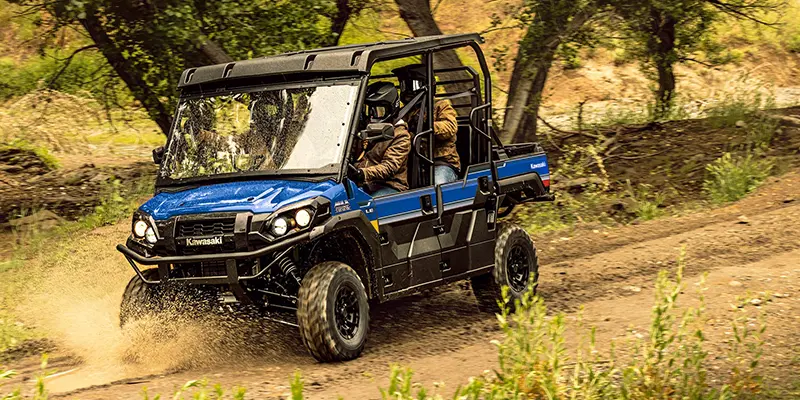
The Mule’s superpower is its Trans-Cab™ system. In about 60 seconds, one person can collapse the rear row of seats and slide the cargo wall forward. This transforms the vehicle from a 6-passenger people mover with a small bed into a 3-passenger workhorse with a massive steel cargo bed. This flexibility is unmatched. If you are dropping the kids off at camp and then need to haul firewood, the Mule adapts instantly.
Kawasaki backs their engineering with a standard 3-year warranty, which is significantly longer than the standard 6-month or 1-year warranties offered by most competitors. For budget-conscious families, this peace of mind is a major selling point.
Buying the machine is just the first step. To truly enjoy 6-passenger riding in our region, we recommend a few key upgrades:
They require more attention to turning angles. Due to the longer wheelbase, you will need to take 3-point turns on tight switchbacks where a 2-seater might whip right around. However, for general fire roads and open trails, they are actually more stable and predictable at speed.
You will likely need to upgrade. Most 6-seater UTVs range from 150″ to 160″ in length. A standard 10 or 12-foot trailer won’t cut it; you generally need a 14-foot or 16-foot tandem axle trailer to haul a Crew model safely and balance the tongue weight correctly.
The Polaris Ranger Crew XP 1000 NorthStar Edition is widely considered the leader in factory-integrated HVAC systems. Its variable compressor and fully sealed cab offer superior cooling compared to aftermarket kits installed on other brands.
You will notice a difference in acceleration, but top speed usually remains high. If you plan to ride with 6 adults constantly, look for models with 80+ horsepower (like the Defender HD10, Ranger XP 1000, or Mule 1000) to maintain “fun” performance levels on steep inclines.
Yes, but proper restraints are key. All major manufacturers include seatbelts and passenger handholds. For smaller children, we recommend aftermarket bump seats or harness upgrades to ensure they are secure. Always check local laws regarding helmet use and age restrictions for passengers.
Expect a 15-20% reduction in fuel range compared to a 2-seat model due to the heavier chassis and increased payload. However, most Crew models come with larger fuel tanks (typically around 10-11 gallons) to compensate for this, giving you a similar total range.
Don’t leave anyone behind on your next adventure. Whether you value the plush ride of the Polaris, the utility of the Can-Am, the reliability of the Honda, or the versatility of the Kawasaki, the 6-seater market has never been more competitive.
The best way to decide is to put your family in the seats. Visit our showroom in Ontario, OR, just a short drive from Boise, and let the kids climb in the back. Seeing how much legroom they really have is the ultimate test.
©2026. Edge Performance Sports. All Rights Reserved.

While great effort is made to ensure the accuracy of the information on this site, errors can occur. Please verify all pricing and installed equipment information with a customer service representative. This is easily done by calling us or visiting us at the dealership.
We improve our products and advertising by using Microsoft Clarity to see how you use our website. By using our site, you agree that we and Microsoft can collect and use this data. Our privacy statement has more details.
Save your favorite vehicles for later viewing on your desktop or mobile devices.
Keep track of all the vehicles you've viewed for a better car shopping experience.
Narrow your search by comparing your favorite vehicles.